Mythos: Ragnarok by Ed Gamester
- Feb 24
- 5 min read
Updated: 5 days ago
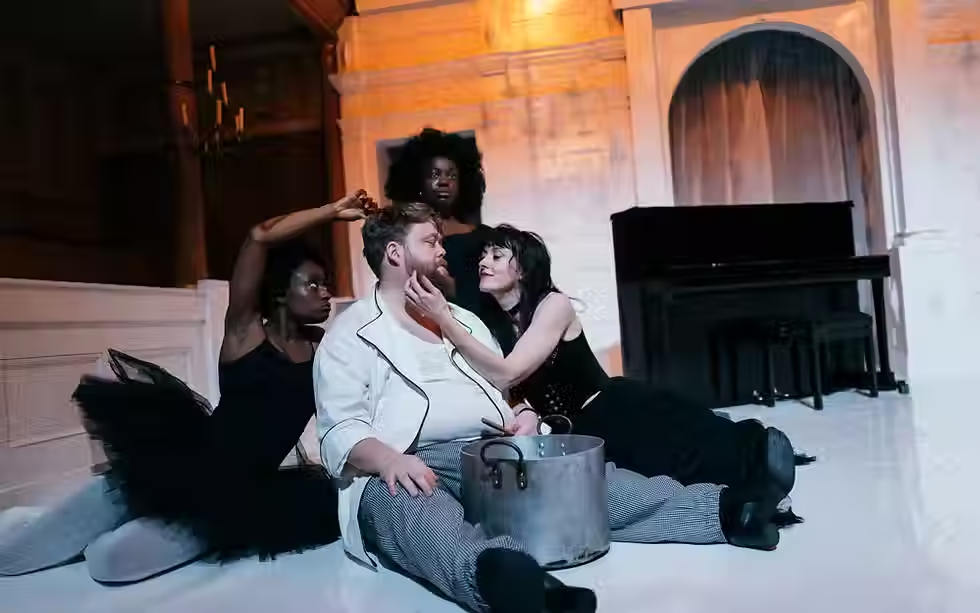
Join Odin, Thor, Freyja, Loki and the Norse Gods in their struggle to outgrow their humble origins, defeat and unite rival clans and overcome each another’s ambitions in this electrifying retelling of Norse mythology. A loving and detailed adaptation of the Prose Edda and associated legends, this is theatre as you have never seen it: fun, visceral, ever-changing and utterly chaotic, just like the myths themselves.
Already one of the top-selling shows of the whole Edinburgh Festival Fringe, what was once a cult classic can now be found at such iconic venues as London’s Alexandra Palace, The Royal Playhouse of The Hague, Delamar in Amsterdam, Oude Luxor in Rotterdam, and The Renaissance Theater of Vienna.
INTERVIEW

Ed Gamester is the man behind groundbreaking sell-out theatrical experience Mythos: Ragnarok which combines norse mythology with the high-octane spectacle of professional wrestling.
Interviewer: Nicole Kent
Where did your love of Norse mythology come from?
I studied ancient Icelandic as part of my degree, but I’ve loved Norse mythology since I was a teenager. I was always fascinated by it. I actually think that fascination goes hand in hand with loving professional wrestling. Norse gods battle over wealth, power, pride, and destiny. Then you’re a kid, you turn on the TV, and you see these huge, archetypal figures battling live in front of you over glory and dominance. If you’re into big characters resolving epic feuds through exaggerated conflict, wrestling and mythology are much closer than people think.
Why focus on Norse mythology? Why not Greek? Could you do Greek in the future?
I love Greek mythology. But Greek gods and mortals are usually quite separate. There’s interbreeding occasionally — Zeus turning into a swan and so on — but generally the gods are elevated, distant figures.
In Norse mythology, the gods feel much more human. They’re dirtier, grittier, closer to the mud. The stories are about crops failing, battles, hunger, survival — they’re grounded.
With Ragnarök, I wanted to almost “de-deify” the gods — to explore their humanity. It’s easier to imagine that Norse gods might have once been mortals who were venerated over time. They have magical armour and weapons — but you could interpret that as just humans who happened to have better tools and were mythologised later.
Is Norse mythology widely known in Europe?
In parts of northern Europe, the myth of Ragnarök is extremely well known. People understand it as a clear, structured narrative. It’s similar to how people know the story of the Trojan War from the Iliad — though that’s a literary epic rather than a purely oral myth tradition. Norse myth, especially Ragnarök, comes from a strong oral storytelling culture across northern Europe and the UK. Depending on where you’re from in Britain, you may have Danish, Norwegian, or Icelandic ancestry. That cultural inheritance is closer than people realise.
Are you Scottish? Does heritage influence the show?
Scottish on my grandad’s side and Irish on my grandma’s. Coastal regions in Britain have strong Nordic influence. In some northern areas, there are still linguistic traces of Icelandic and Norwegian roots. A lot of Scottish dialect contains Northern European words. That heritage runs much deeper in our culture than people think — and it absolutely feeds into the show.
You wrote, produced, directed, and performed in it?
Yes — I wrote it, produced it, directed it, and perform in it. It merges three worlds that don’t usually mix:
Mythology
Theatre
Professional wrestling
There have been ballet adaptations of Norse figures, but never a wrestling-theatre hybrid done properly. People often think wrestling is just muscles and slamming. But it’s storytelling — plot devices, character arcs, conflict resolution. I wanted to honour wrestling as an art form, while also respecting the thousand-year tradition of Norse myth. And wrestling is dangerous. You can’t hand that to someone who doesn’t understand it physically.
Why take on so much responsibility yourself?
No one believed it would work. So if no one else was going to do it, I thought I’d better do it myself. We scraped together a couple of thousand pounds from my stunt work, staged the first show, made a little money, and grew from there. It was about quality control. I love these worlds deeply — I didn’t trust anyone else to protect them properly.
Is wrestling choreographed like dance?
Wrestlers choreograph their own matches. A good wrestler might perform dozens of times a year and sometimes plans a match with only ten minutes’ notice. It’s structured improvisation. There are key beats — but audience reaction shapes everything. It’s a two-way conversation, like clowning or improv comedy. That’s why every show feels electric. No two are identical.
What has your experience at the Edinburgh Fringe been like?
Incredible and brutal. We began at the Gilded Balloon, then scaled up:
200 seats (sold out)
500 seats
550 seats
Now 700 seats
But it’s expensive — tens of thousands of pounds — and physically punishing. We wrestle every night for nearly a month. We don’t pay promoters. We wrestle outside in the street ourselves to sell tickets. That honesty connects with people.
Do you get injured?
Yes. I’ve had concussions. I split my head open once and needed five stitches — and still performed. It’s intense, but the authenticity is part of what makes it powerful.
Do international audiences react differently?
We performed 25 shows in Austria with German subtitles. Comedy is hard to translate — timing suffers. British audiences tend to catch the wit quickly. Austrian audiences responded more to the physical spectacle.Cultural context shapes reaction.
Your partner designs the set?
Completely. She handles everything visual — anything that looks cool is her. Anything funny or violent is me. We met during lockdown. When restrictions lifted, she moved in. Lockdown made me rethink everything — wrestling is physically demanding. I didn’t want to do it forever just because I had to. So we built something of our own.
Would you turn it into a film or Netflix show?
Yes and no. The story could work on screen — but the soul of it is live performance. I’ve performed it for around 60,000 people. Every audience experience is different.
People have flown from Cuba and Australia to see it. Kids come back with school projects inspired by it. That electricity can’t be replicated on screen.
Are most audience members wrestling fans?
Surprisingly, most aren’t wrestling fans. They come for the myth, the folklore, the cultural experience. Wrestling fans eventually hear about it because it’s unique — but the average audience member comes for story.
What feedback has meant the most?
When parents tell me their child — who never leaves their room — came out because of the show. Applause can be polite. But people queuing for an hour to shake your hand — that’s real. You can’t fake that.
What do you want audiences to take away?
Two things:
I want adults to feel the awe I felt watching wrestling as a child — fully immersed, unsure what’s real.
I want people to understand wrestling as a storytelling craft.
We don’t use referees. We don’t present it as “a wrestling match.” We use the physical language of wrestling the way theatre uses sword fighting or film uses action sequences.
If people leave understanding wrestling differently, then I’ve improved its standing in the public eye. That’s my contribution.
💛 Date: 20th March 2026 – 2nd May 2026
💛 Location: Alexandra Palace Theatre, Portugal St, London WC2A 2HT
💛 Time: 7:30 pm
💛 Tickets:https://mythosragnarok.co.uk/about
Maddest, baddest show of the Fringe - ★★★★ Daily Mail
A knockout spectacle - ★★★★ The Telegraph
An unmissable blockbuster - ★★★★★ London Theatre 1


Comments